
Few spirits carry as much drama in a single glass as absinthe. It’s been banned, blamed, and romanticized, and it eventually made a comeback. For over two centuries, this emerald-hued liqueur has swung between “dangerous poison” and “muse of geniuses.” Here’s the real story behind La Fée Verte, the Green Fairy, and why she still fascinates drinkers and gift-givers alike.
What Is Absinthe, Exactly?
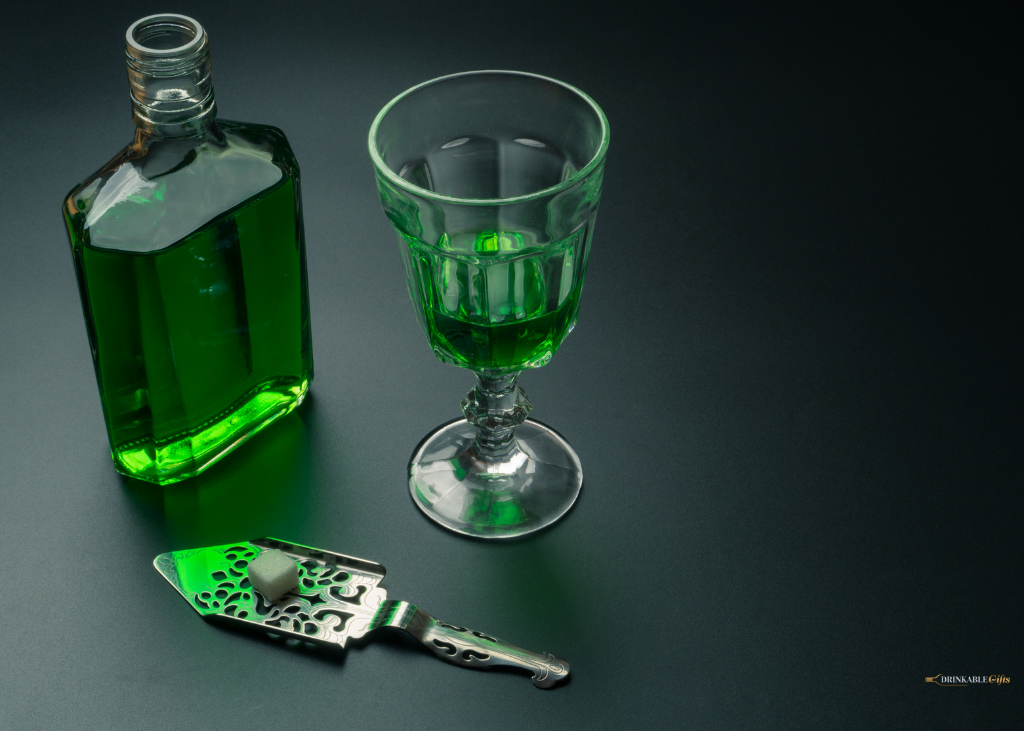
Absinthe is a highly alcoholic, anise-flavored spirit. Distillers make it from botanicals, most notably wormwood (Artemisia absinthium), green anise, and fennel, often called its “holy trinity.” The name traces back to the Latin absinthium, which itself came from the Greek apsínthion, meaning wormwood. Depending on style, this spirit can run anywhere from 45% to 74% ABV (90 to 148 proof). That makes it one of the strongest commercially available liquors in the world.
Chlorophyll gives it a signature emerald color, released during a final maceration of herbs like petite wormwood and hyssop. Add cold water, though, and the liquid turns cloudy and opalescent. People call this visual transformation the louche effect, and it’s one of the drink’s most recognizable, and most searched-about, characteristics.
The Birth of the Green Fairy
The commercial story starts in late 18th-century Switzerland, where sellers originally marketed absinthe as a medicinal tonic. By the mid-1800s, it had crossed into France and exploded in popularity, especially among Parisian bohemians. People came to know the daily ritual of an early-evening glass as l’heure verte, “the green hour.” Many historians credit that phrase as the conceptual ancestor of the modern happy hour.
Its cultural footprint from this era is enormous. Artists like Vincent van Gogh, Pablo Picasso, Henri de Toulouse-Lautrec, Oscar Wilde, Edgar Allan Poe, Ernest Hemingway, and James Joyce all drank it, and so did the occultist Aleister Crowley. Oscar Wilde reportedly called a glass of it “as poetical as anything in the world.” Hemingway later immortalized it, too, in his cocktail “Death in the Afternoon,” which mixes the spirit with chilled champagne.
Myth vs. Reality: Did Absinthe Really Cause Hallucinations?
This is the question everyone searches for, and it deserves a clear answer. No, this drink does not cause hallucinations. At least, not in the way legend claims.
The myth centers on thujone, a naturally occurring compound in wormwood. It does have real activity in the brain: it can block a receptor that normally calms neural activity, and in very large doses, it can cause seizures. So nineteenth-century critics claimed the spirit contained dangerously high thujone levels, capable of triggering visions and madness. They even dubbed this supposed condition “absinthism.”
Modern chemistry tells a different story, though. In a landmark 2008 study, researchers in Germany, England, and the U.S. tested actual pre-1915 vintage bottles. They found thujone levels far too low to produce psychoactive effects, comparable to, and sometimes lower than, today’s product. In other words, high alcohol content, not a mysterious hallucinogen, almost certainly caused the wild “effects” drinkers reported. As one food chemist behind the research put it, decades of moral panic rested on a chemical scare that never held up under analysis.
Why the Myth Wouldn’t Die
If it wasn’t a hallucinogen, why did the legend stick so hard? A few forces converged.
- Temperance politics. France’s wine industry took a hit from the phylloxera blight in the late 1800s. So winemakers saw the newcomer as a cheap competitor and backed campaigns against it hard.
- Sensational crime coverage. In a notorious 1905 Swiss case, a man killed his family after drinking absinthe along with several other drinks. The press dubbed it “the absinthe murders,” and the coverage fueled a national panic. Switzerland banned the spirit by referendum soon after, and France followed in 1915.
- Artist mythology. So many troubled, brilliant artists drank it that the public assumed the drink caused their instability, rather than simply being the popular spirit of the era. In fact, historians now note that conditions like syphilis more plausibly explain some of the era’s most famous breakdowns.
Banned for Nearly a Century, Then Reborn
By 1915, most of Europe had banned it, and the United States followed later. For the better part of a century, it survived only in a handful of countries and in the public imagination, mythologized as a forbidden, borderline-narcotic drink.
That began to change in the late 20th century. Researchers revisited the thujone question and found the science didn’t support the ban. So restrictions started lifting across Europe in the 1990s and 2000s, and in 2007, the United States legalized absinthe again, as long as it meets modern food-safety limits on thujone content. Today it’s a legitimate, regulated spirit. Its risk profile is no different from any other high-proof liquor, as long as people enjoy it responsibly.
The Absinthe Ritual
Part of its enduring appeal is the ceremony around drinking it. Here’s the classic preparation:
- Pour a measure of the spirit into a glass.
- Rest a slotted absinthe spoon across the rim, and place a sugar cube on top.
- Slowly drip ice-cold water over the sugar cube, dissolving it into the liquid below.
- Watch the drink turn cloudy as the louche effect unfolds, releasing its full aromatic complexity.
Interestingly, historians note that this elaborate spoon-and-fountain ritual, as we know it today, actually started as a marketing revival in the late 1990s. Films depicting the Belle Époque later cemented it in pop culture. Whatever its exact origins, though, it remains one of the most theatrical ways to serve any spirit. That’s exactly why themed gift sets make such memorable presents.
The Three Faces of Absinthe
- Verte (green): The traditional style, colored naturally by chlorophyll during a final herbal maceration. Most complex and herbaceous.
- Blanche (clear): Skips the coloring step for a cleaner, brighter anise-and-fennel profile.
- Rouge (red): Uses additional botanicals for a spicier, amber-red variation.
Absinthe Today: Muse, Myth, and Gift
Two centuries after its invention, the Green Fairy has shed her outlaw reputation without losing her mystique. Mixologists love her anise-forward complexity, and collectors are drawn to her storied history. Plus, thanks to that unmistakable louche ritual, she remains one of the most memorable spirits to give as a gift. Whether the recipient is drawn in by the art history, the science-versus-legend intrigue, or simply the ceremony of the pour, absinthe delivers an experience far beyond what’s in the glass.
Looking for the perfect way to introduce someone to the Green Fairy? A well-chosen absinthe gift set, complete with bottle, spoon, and glass, turns two centuries of legend into an experience they can enjoy at home.
Ready to Send a Little Bit of Legend?
- Browse our absinthe and specialty spirits collection and find a bottle worthy of the Green Fairy’s reputation.
- Subscribe to our newsletter and save 10% on your first order for more curated ideas on rare, storied, and conversation-starting spirits.
- Read more about historical and national drinks with our blog.

Passionate about friends, family, music, soccer, gifts, travel, and lifelong learning, Otavio Ribeiro has been contributing his marketing expertise to Drinkable Gifts as Brand Manager since 2025.
A Brazilian holding dual nationality with Portugal, Otavio also has a deep love for writing. His guiding principle and favorite quote is, “Be so good they can’t ignore you.”